Pages

Sonntag, 30. März 2014

Whoa, Dude, Are We Inside a Computer Right Now?

NASA scientist Rich Terrile is a supporter of the theory that the human experience is  an incredibly advanced, metaphysical version of the Sims. The author of the text, Ben Makuch, uses ethos in his introduction to gain supporters for Terrile’s theory by saying that he is a highly praised scientist and director of NASA’s Jet Propulsion Laboratory. In the interest of supporting his theory, Terrile provides the reader with valid arguments. First, he uses ethos and says that his theory is a result of a combination of several things, like working in the fields of evolutionary computation and artificial intelligence. Then he goes on by using logos and explains that there is a finite number of things the universe can be, and those are computable. If they behave in a finite way, when being observed, then the question arises whether it is being computed. Also, “if two things are mathematically equivalent, they are the same. So the universe is mathematically equivalent to the simulation of the universe.” In order to evoke any kind of emotion, Terrile mentions the possibility that our lives are being controlled by a 13-year old teenager in Korea playing on his Xbox. By saying this, Terrile tries to implement a dose of humor into the text.

(210 words)


Freitag, 21. März 2014

PSA After-Death Avatars

After-death avatars cannot bring back your loved ones nor can they replace them. Software will never be able to think, speak or act like your loved one would. Do not get fooled by them. If you are having a hard time dealing with the death of a family member or friend, seek professional help.

Say no to after-death avatars.


(59 words)


"You only live once, but if you do it right, once is enough." Mae West

Samstag, 15. März 2014

A day in the life of...me! :)

“I need more sleep”. My first thought in the morning is how I need to go to bed earlier today and finally get a good night’s sleep. I usually have troubles falling asleep and most of the time end up staring at the ceiling. Therefore, I really appreciate the days when I am so exhausted that I just crash.


After getting out of bed my thoughts wander on what my tasks for the day are. I think about what I have to study for and the homework I still have not finished. The work keeps pilling up and my initial motivation for the day is starting to drop. University is a must on almost every day of the week. Although hard work is ahead of me there I also know that it is the place where I meet my friends, where we talk about our hopes and fears.

This leads me to another very important aspect of my day, my friends. My friends keep me going, they help me get up when I fall and encourage me to be the best possible version of myself. Whenever I feel like giving up, they are here to push me back into the game. I cannot imagine my life without them, I probably would not be the person I am today.


(218 words)

"What does it matter how many lovers you have if none of them gives you the universe?" 
Jacques Lacan


Sonntag, 19. Januar 2014

Pronunciation diary #2

Hey guys,

It is time to talk about pronunciation again. Yay, who does not like pronunciation? ;) This is the second part of my pronunciation diary.

I want to share with you my method that I used while studying for my oral exam on Thursday. The oral exam is over!!! :D I felt such a relief after I was done with it. It was not bad at all. I was afraid of it, but it turned out good. :) Besides learning the Porter words, I also had to work on my pronunciation.

In my last feedback Frank told me that my biggest problems are that I speak too fast and the “th” sound. I needed to work on those two things before the exam. I know that I speak too fast and it is really a problem because sometimes my own mother cannot understand me. Most people just speak really quickly in their mother tongue, but I speak like that in every foreign language I am fluent in. Now, I try to speak slowly and enunciate my words, but sometimes I forget, and slip back into my old talking speed. I worked on that with my roommate. I would get a text and read it out loud, if she could follow, then the speed was good, if she could not, then I had to do it again, but more slowly this time. We went through many texts. In the end it was worth it. I think that I am now able to speak in appropriate speed when I am talking in class or reading a text out loud. However, I think that I will still read/talk fast when I am not in class. Sorry, I cannot really help it. Blessing or curse? :S

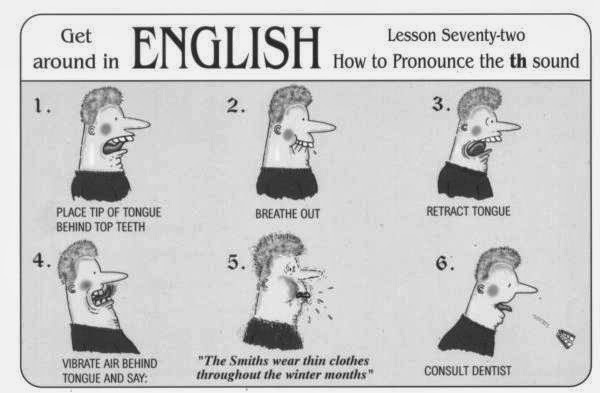
Furthermore, I had to work on the “th” sound. It is not really that I do not know how to pronounce it, but sometimes I am lazy when I read/speak and I just mispronounce it. Since Youtube is a great source for basically everything I looked up how to correctly pronounce words that contain “th” and came across this video http://www.youtube.com/watch?v=h5LO0hHGfQg I recommend watching it. It is not long and it really helps. Side-effect, you might spit around while trying to imitate the guy but that is ok ;) After some time spent spitting around, I found this pronunciation practice sheet http://www.vitaeducation.org/wp-content/uploads/2010/05/th-sound-Handout.pdf

Again, my roommate and I decided to do it together. Honestly, we looked like nutcases ready to be hospitalized while yelling out words containing “th”. We even made up our own language:

A: Three! (Hi!)
B: Three! Thirteen? (Hi! How are you doing?)
A: Thousand! There? (Great! You?)
B: Bathroom :( (Not good.)

As you can see we had a lot of fun practicing our pronunciation. As I said in my other blog post I wrote about pronunciation, practicing it can be really fun. It all comes down to your attitude. If you go in and start learning it while thinking “I hate this crap, let's just get it over with” you will hate it. However, if you have a positive attitude things will be much easier.

XOXO A.

“Live as if you were to die tomorrow. Learn as if you were to live forever.”  Mahatma Gandhi

Freitag, 17. Januar 2014

Reflection on Pecha Kucha

It feels like Pecha Kucha was ages ago, but in reality it was just before Christmas. We were working on many projects this semester and had to write a lot of homework. Since we are getting close to the end of the winter semester, it is time to look back at what we have done. One of our biggest projects was the Pecha Kucha project. Pecha Kucha what? Pecha Kucha is a presentation style in which 20 slides are shown for 20 seconds each (six minutes and 40 seconds in total).

When Frank told us to research it for homework I had no idea what it was. I read through some blog posts and articles, but did not give it much thought until Frank told us that we will have to do a presentation like this ourselves! I thought he was joking. I do not know what to tell you. Usually I cannot wait to do a presentation, but that was not the case with Pecha Kucha. First, we got a partner for our project. Mine was Katharina and we got along well. Then, we were supposed to choose a topic. The topics were actually really interesting. Mine was the Maltese language. I loved my topic. When I was on Malta in 2011 I thought I would understand what they are talking because I assumed that the language is similar to Italian, which I speak a little. The truth is, I did not understand a single word because it is nothing like spoken Italian. When I was given the chance to do research on Maltese I was really excited. I learned that Maltese is the only Semitic language written with Latin letters. While preserving its Arabic roots, it the course of its history, Maltese pronunciation and words has been subject to strong influence from Italian and, more recently, English. Maltese, as well as English are the official languages in Malta.

My peers had also good topics for their presentations. Laura and Andrina talked about the Slovenian, and Harald and Orsy about the Hungarian language in Austria. Another cool topic was bilingual schools in Austria. If I would have to judge Pecha Kucha on the topics I listened to, I would say that it was an awesome project and that I would love to do it again, but that is not the case. Honesty is the best policy, right? I hated Pecha Kucha. I hated the way I had to present my topic. I think that every single topic we had to do was fun and that we could have learned so much from the presentation, but it was not like that. In my opinion, the whole learning process got lost in the nervousness of presenting. I know how I felt, at least. I was really under stress because of it. It is not easy to have to present one slide in exactly 20 seconds. When practicing I was either too slow or too fast, or I could not remember my lines. I was also nervous because I did not know whether our videos are going to work or not. On presentation day, at least I think so; I and my partner lost it. She was too slow and talked into my slide, and then I had to be super-fast to catch up and stay within the 20 seconds. Whenever I would catch up she would again be too slow. On one slide I could not remember my lines so I had to leave out a sentence or two. I could not wait for the presentation to be over, honestly.

I never ever want to do a Pecha Kucha presentation again. It was no fun to me, on the contrary my heart started racing, my hands started sweating and a total chaos was in my head. I really love doing presentations; it is one of my favorite parts of class. For instance the last year’s Culture Project was one of my highlights from my first year in university. I really enjoyed doing that presentation. Everyone was so relaxed and looking forward to presenting something they have been working on for weeks. Though we had a limited time there as well, the pressure was not that big. If I would ever get the chance to do either Pecha Kucha or Culture Project again, my answer would be the latter. Maybe my peers liked my Maltese presentation, maybe they did not, I do not know since we did not get any feedback. What I do know, however, is that I am not satisfied with the way I presented it. I hope you guys are satisfied with how you presented your presentation and that you had more fun doing it.


XOXO A.

"Life begins at the end of your comfort zone" :)

Donnerstag, 16. Januar 2014

Serbia's requirements for the EU - Corrected Version

Hey friends,

check out the corrected version of our paper for Melissa and Fiona on Tiana's blog. Our topic was "Serbia's requirements for joining the EU". Thank you :)


http://tiana-afterglow.blogspot.co.at/2014/01/serbias-requirements-for-eu-corrected.html


XOXO A.

"It is not about what you have done, it is about what you are doing!"

Samstag, 4. Januar 2014

Pronunciation Diary #1

How do we pronounce words in a language? Pronouncing words comes naturally in our mother tongue. We learn to talk by imitating the communication of people around us. Sure, learning how to talk is not mere imitation, but is still a vital part of the process. The words and sentences we construct as children often do not make much sense and do not follow any grammatical pattern. As we are growing up our language skills are improving. We all speak our native languages fluently without being able to explain why that is so. The chances of speaking a foreign language at a fluency level are higher when we are children. It is a known fact that children learn by listening and jabbering, no declension tables or vocabulary lists. As we grow up and reach puberty, our ability to acquire a foreign language at fluency level gets lost. No one can really explain why that is so.

 A vital part of learning a foreign language is the pronunciation of words. As mentioned above when picking up a new language as a child, the pronunciation of words comes naturally, but if you start learning it as an adult, things become tricky. For instance, Croatians and people that start learning Croatian as children have no problems with pronouncing the letters č, ć, š, ž, đ and dž. However, others who start learning it later in life have troubles pronouncing words containing those letters. That is the same in English. Certain letters or letter pairs are hard to pronounce, such as “th”. German native speakers tend to pronounce “thousand” wrong because it is very similar to the German word “tausend”. I also have problems with pronouncing “th”. When I concentrate on what I am reading I pronounce it correctly, but when I am tired or do not concentrate on the text I make mistakes. Bathroom, throne, theory, thesis and thriller all contain “th”.  Essential to sounding like a native speaker is picking up the right pronunciation. Learning pronunciation cannot be left until later because it will be harder to re-learn the words we already know in the correct way. When talking to an English native speaker he might not notice your limited vocabulary or bad grammar at first, but he will notice your bad pronunciation.


So what can I do to improve my pronunciation? What can you do? One way is to watch YouTube videos that deal with that topic. Frank introduced us to Amy and Rachel, two women that have a series of videos where they are explaining how to pronounce words properly. It can be very helpful to look at those videos. I have my own method. Whenever I come across a word I do not know how to pronounce or an old one I am not sure if I am pronouncing correctly, I search for an online dictionary. Those usually have a sound button where you can hear how the word is pronounced. What also helps me and what is my favorite thing to do is skyping with my friends from the States. I usually have a list of words I want to ask them how to pronounce. First, I try to pronounce them and then they correct me if needed. I also love watching series and movies in English, as well as listening to music. Many times I realized, by watching a movie that I am pronouncing a word wrong by hearing the actor say it. What I find particularly fun while learning pronunciation is watching Ronnie's videos. Andrina, a very nice girl from my class, introduced Ronnie to us in class. I liked her videos so much that I looked them up at YouTube and started watching. Ronnie is so nice and makes learning proper pronunciation fun. I highly recommend watching her videos. This is her YouTube channel http://www.youtube.com/user/EnglishLessons4U?feature=watch

Here is another link about 5 key areas in which non-native English speakers have problems

“Dearest creature in creation,
Study English pronunciation.
I will teach you in my verse
Sounds like corpse, corps, horse, and worse.
I will keep you, Suzy, busy,
Make your head with heat grow dizzy.
Tear in eye, your dress will tear.
So shall I! Oh hear my prayer.
Just compare heart, beard, and heard,
Dies and diet, lord and word,
Sword and sward, retain and Britain.
(Mind the latter, how it’s written.)
Now I surely will not plague you
With such words as plaque and ague.
But be careful how you speak:
Say break and steak, but bleak and streak;
Cloven, oven, how and low,
Script, receipt, show, poem, and toe.
Hear me say, devoid of trickery,
Daughter, laughter, and Terpsichore,
Typhoid, measles, topsails, aisles,
Exiles, similes, and reviles;
Scholar, vicar, and cigar,
Solar, mica, war and far;
One, anemone, Balmoral,
Kitchen, lichen, laundry, laurel;
Gertrude, German, wind and mind,
Scene, Melpomene, mankind.
Billet does not rhyme with ballet,
Bouquet, wallet, mallet, chalet.
Blood and flood are not like food,
Nor is mould like should and would.
Viscous, viscount, load and broad,
Toward, to forward, to reward.
And your pronunciation’s OK
When you correctly say croquet,
Rounded, wounded, grieve and sieve,
Friend and fiend, alive and live.
Ivy, privy, famous; clamour
And enamour rhyme with hammer.
River, rival, tomb, bomb, comb,
Doll and roll and some and home.
Stranger does not rhyme with anger,
Neither does devour with clangour.
Souls but foul, haunt but aunt,
Font, front, wont, want, grand, and grant,
Shoes, goes, does. Now first say finger,
And then singer, ginger, linger,
Real, zeal, mauve, gauze, gouge and gauge,
Marriage, foliage, mirage, and age.
Query does not rhyme with very,
Nor does fury sound like bury.
Dost, lost, post and doth, cloth, loth.
Job, nob, bosom, transom, oath.
Though the differences seem little,
We say actual but victual.
Refer does not rhyme with deafer.
Foeffer does, and zephyr, heifer.
Mint, pint, senate and sedate;
Dull, bull, and George ate late.
Scenic, Arabic, Pacific,
Science, conscience, scientific.
Liberty, library, heave and heaven,
Rachel, ache, moustache, eleven.
We say hallowed, but allowed,
People, leopard, towed, but vowed.
Mark the differences, moreover,
Between mover, cover, clover;
Leeches, breeches, wise, precise,
Chalice, but police and lice;
Camel, constable, unstable,
Principle, disciple, label.
Petal, panel, and canal,
Wait, surprise, plait, promise, pal.
Worm and storm, chaise, chaos, chair,
Senator, spectator, mayor.
Tour, but our and succour, four.
Gas, alas, and Arkansas.
Sea, idea, Korea, area,
Psalm, Maria, but malaria.
Youth, south, southern, cleanse and clean.
Doctrine, turpentine, marine.
Compare alien with Italian,
Dandelion and battalion.
Sally with ally, yea, ye,
Eye, I, ay, aye, whey, and key.
Say aver, but ever, fever,
Neither, leisure, skein, deceiver.
Heron, granary, canary.
Crevice and device and aerie.
Face, but preface, not efface.
Phlegm, phlegmatic, ass, glass, bass.
Large, but target, gin, give, verging,
Ought, out, joust and scour, scourging.
Ear, but earn and wear and tear
Do not rhyme with here but ere.
Seven is right, but so is even,
Hyphen, roughen, nephew Stephen,
Monkey, donkey, Turk and jerk,
Ask, grasp, wasp, and cork and work.
Pronunciation (think of Psyche!)
Is a paling stout and spikey?
Won’t it make you lose your wits,
Writing groats and saying grits?
It’s a dark abyss or tunnel:
Strewn with stones, stowed, solace, gunwale,
Islington and Isle of Wight,
Housewife, verdict and indict.
Finally, which rhymes with enough,
Though, through, plough, or dough, or cough?
Hiccough has the sound of cup.
My advice is to give up!!!”

Gerard Nolst Trenité, Drop your Foreign Accent

XOXO A.